

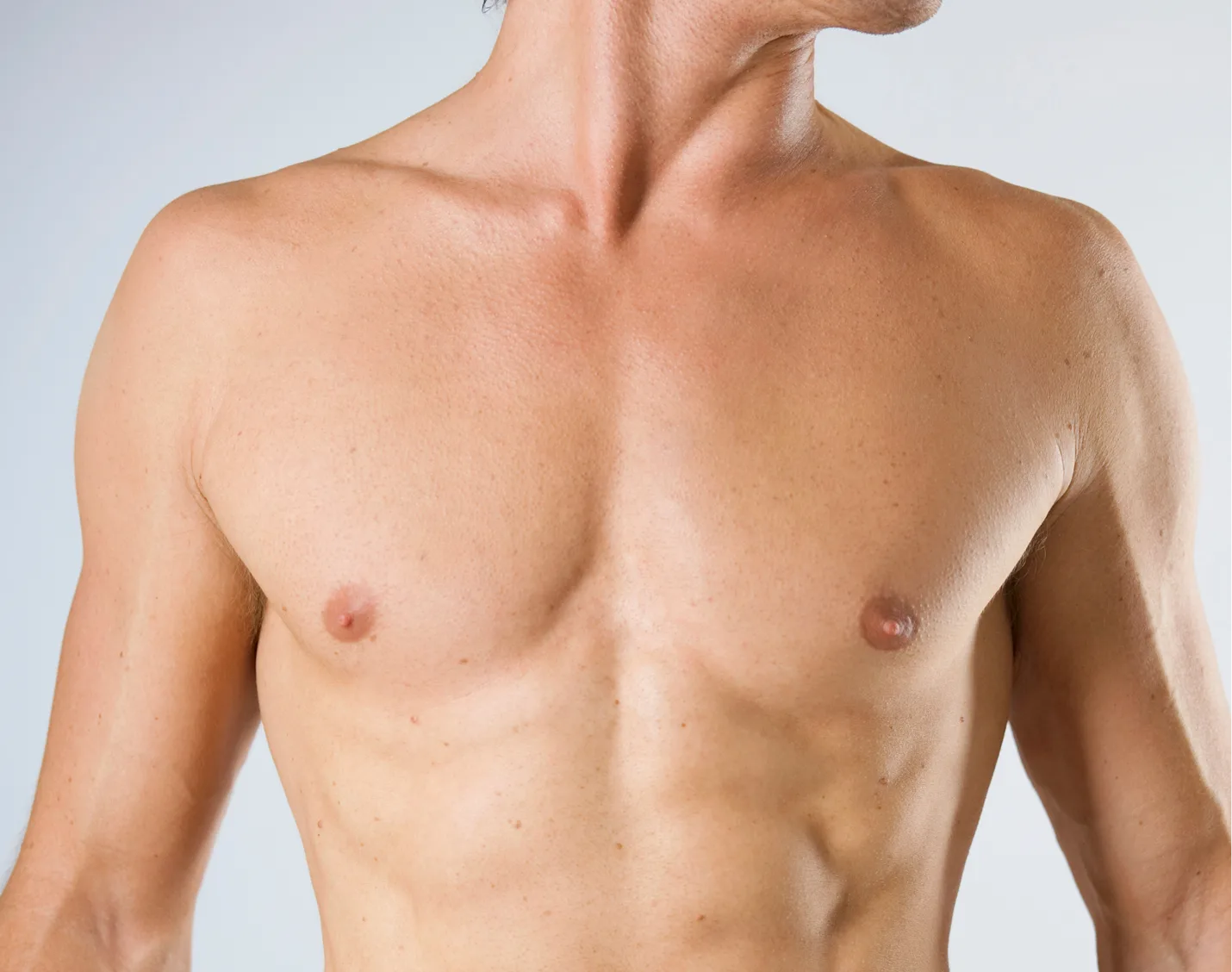
8 Signs of Gynecomastia Most Men Overlook
The visual presentation varies more than most people expect. Not everyone has the dramatic, obviously rounded chest that shows up in before-and-after photos. A lot of men with gynecomastia look almost normal in a shirt, with the issue only becoming obvious shirtless or in form-fitting fabric. Some men have carried it for ten years without anyone else ever noticing.
That doesn’t mean it isn’t there. These are the specific things to look for.
Puffy or protruding nipples. The areola has a domed or raised appearance even when the rest of the chest is relatively flat. This happens when glandular tissue directly behind the nipple pushes outward on the skin. It tends to be the first thing men notice, especially in cold temperatures or after exercise, when the nipple should retract but doesn’t fully. In some cases, the nipple itself doesn’t protrude much, but the entire areola appears raised and slightly cone-shaped against an otherwise flat chest.
A rounded or soft appearance in the lower chest. Instead of a defined lower pec border, there’s a soft curve that makes the chest look fuller than it should. This is subtle enough that it reads as “just needs more gym time,” which is exactly why men with gynecomastia can spend years training before anyone mentions that training won’t fix it
A firm or rubbery lump behind the nipple. This is the most clinically consistent sign. The tissue doesn’t feel like the surrounding chest — it’s denser, sometimes tender, and sits directly beneath the areola. It can range from a small button-sized mass to something more spread out. Men who press firmly and feel nothing distinct are usually dealing with fat rather than gland.
Asymmetry between sides. Gynecomastia doesn’t always develop equally on both sides. One breast can be noticeably more developed than the other, showing up as a visible difference in nipple position or chest contour. Asymmetric presentations are fairly common in our experience and tend to cause more self-consciousness than bilateral cases because the irregularity is harder to explain away.
Skin that doesn’t sit flat. When you press a fitted shirt against your chest, the fabric should follow the muscle. In men with glandular tissue present, there’s often a lift or protrusion at the nipple area that no amount of posture adjustment fully corrects. It’s most noticeable in athletic or compression-fit shirts, which is often why men with gynecomastia gravitate toward looser fits.
Nipple sensitivity or tenderness. Not all gynecomastia is painful, but glandular tissue can be sensitive in a way that chest fat generally isn’t. Some men notice tenderness when the chest is pressed or a low-level ache that comes and goes. If the tissue feels sore to the touch in a specific localized area rather than diffusely across the chest, that pattern is worth paying attention to.
A chest that improves with weight loss but never fully resolves. When a man loses weight, and the chest gets better, but there’s always something left behind, no matter how lean he gets, that’s a strong indicator that the gland is involved. Fat responds to a caloric deficit. Gland doesn’t. The partial improvement is actually one of the more telling signs because it suggests two things are happening at once.
Tissue that feels different from the surrounding chest wall. Even without a distinct lump, glandular tissue has a different texture than fat or muscle. Some men describe it as slightly grainy or fibrous when they press carefully around the nipple. That texture difference, particularly in a ring around the areola, often indicates glandular involvement even when the visual presentation isn’t dramatic
The Physical Test Most Men Can Do Themselves
Lie flat on your back. Place your thumb and index finger on opposite sides of the nipple and slowly bring them together with light pressure toward the center.
If there’s only fat present, your fingers will meet without resistance, and the tissue compresses evenly, like pressing into a pillow. If glandular tissue is there, you’ll feel something firmer underneath — a disk-like or rubbery mass directly behind the nipple. It may or may not be tender when you press it, but the firmness is distinct, and once you feel it, it’s hard to mistake for anything else.
This isn’t a clinical diagnosis, but it’s the same basic maneuver a physician uses in a physical exam. Gland has texture. Fat doesn’t.
When to Stop Guessing and Get an Evaluation
If the self-exam suggests something firm is there, or if you’ve been dealing with a chest appearance that doesn’t respond to training for more than six months to a year, it’s worth an actual evaluation rather than continuing to manage it mentally. It’s also worth knowing that some men have pseudogynecomastia — chest enlargement caused entirely by fat with no glandular tissue involved — or a mix of both, which is why the chest can improve with weight loss but never fully clear up. That partial improvement tends to mislead people for years.
A physical exam by someone who regularly performs gynecomastia surgery in Boston will give you a clear answer about what’s present, how much of it is glandular versus fatty, and what your realistic options are. That conversation takes twenty minutes and tends to be more clarifying than years of quiet uncertainty.
One thing worth noting: gynecomastia that develops suddenly, appears in only one breast, or comes with nipple discharge should be evaluated promptly. These presentations can occasionally signal something unrelated to typical hormonal gynecomastia and deserve medical attention beyond a cosmetic consultation.
What Comes After Knowing
For a lot of men, the relief of finally having a name for something, and understanding why training never fixed it, is meaningful on its own. It shifts the framing from a personal failure to an anatomical reality. The chest didn’t change because the chest couldn’t change with what you were doing.
What you do with that information is a separate decision. Some men want to address it right away, others want to sit with it. But when you’re ready to get a straight answer, that’s what we’re here for. At Regeneris, we see this conversation play out regularly, men who’ve been carrying this for years finally getting clarity on what’s actually there and what can be done about it. Knowing is almost always better than the quiet uncertainty that runs in the background when something feels off, and nobody has told you the truth yet.
Peak Masculinity
Starts Here

By Dr. Ryan Welter
March 9, 2026