

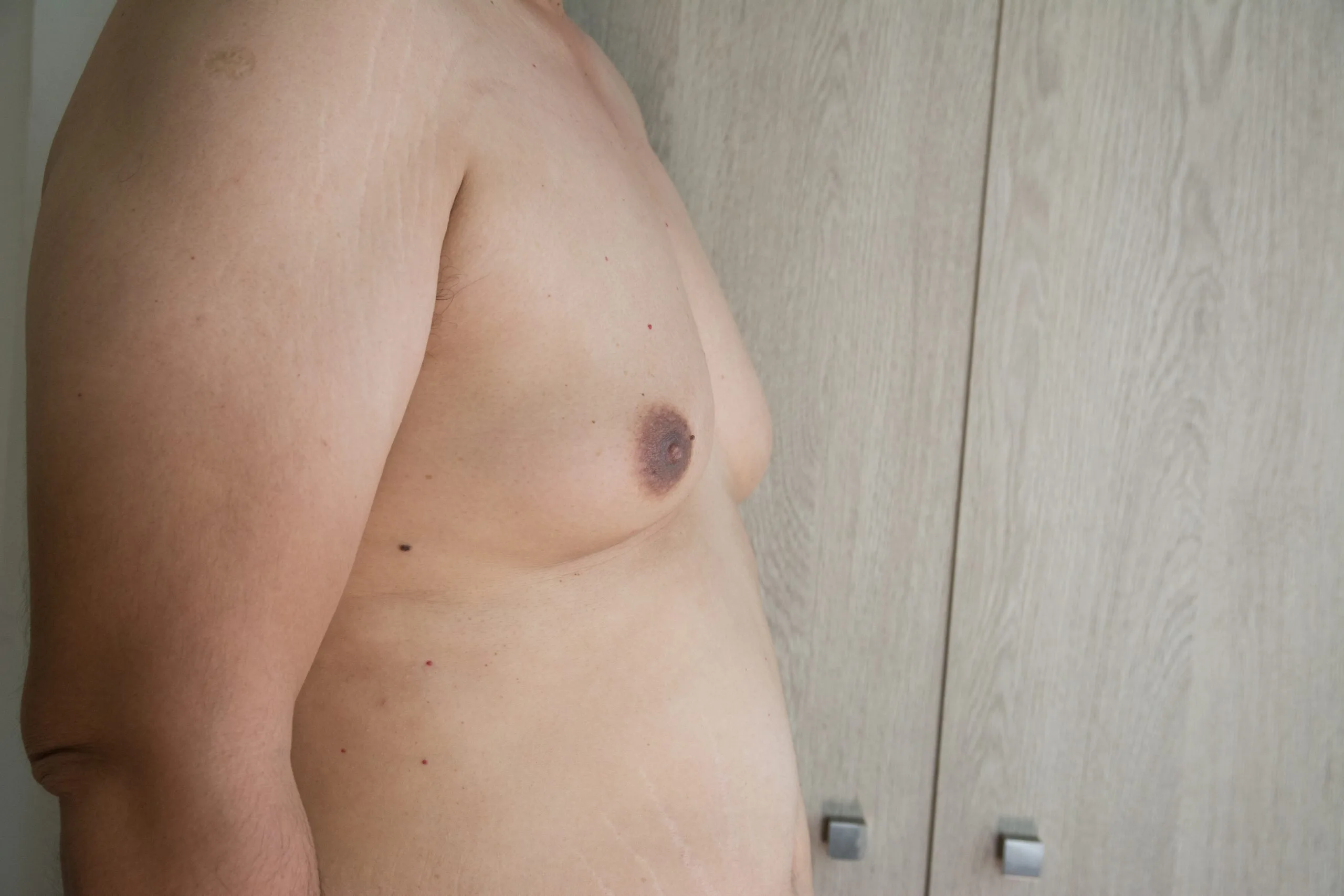
The Key Signs of Gynecomastia
Gynecomastia presents differently from general chest fat, and recognizing the difference is the first step toward the right solution.
Firm or rubbery tissue behind the nipple. This is the hallmark sign. Gynecomastia involves actual breast gland tissue, which feels distinctly different from the soft, even distribution of body fat. You may notice a firm disc or mass centered directly behind or around the nipple-areola complex. It might be tender to the touch, especially in earlier stages.
Swelling that doesn’t match your body composition. If you’re relatively lean, or you’ve lost significant weight, and your chest still appears rounded or puffy, that’s a strong indicator. Fat loss reduces adipose tissue throughout the body, but it doesn’t shrink glandular tissue.
Puffy or protruding nipples. One of the most visible and most frustrating signs. Glandular tissue sitting directly beneath the nipple can push it outward, creating a pointed or dome-shaped appearance that shows through shirts.
Unilateral or bilateral presentation. Gynecomastia can affect one side or both. Asymmetry is common and doesn’t necessarily indicate a more serious issue, but it should always be evaluated.
Tenderness or sensitivity. Some men experience soreness or heightened sensitivity in the chest area, particularly when the tissue is actively growing or during hormonal shifts.
A Simple Self-Check
While nothing replaces a professional evaluation, you can perform a basic self-assessment at home. Lie flat on your back and use your fingers to gently press around the nipple area. If you feel a defined, firm mass beneath the nipple , something that feels distinctly different from the surrounding tissue , that’s consistent with gynecomastia. If the tissue feels uniformly soft and blends evenly into the rest of your chest, you may be dealing with pseudogynecomastia, which is excess fat without glandular involvement.
What to Do Next
If the signs above sound familiar, the most productive next step is a consultation with a specialist who understands the condition. Dr. Ryan Welter evaluates gynecomastia patients regularly at Regeneris Elite Men’s Health Center and can determine within a single visit whether you’re dealing with true gynecomastia, pseudogynecomastia, or a combination of both.
From there, he’ll walk you through your options, clearly, confidentially, and without pressure. If surgery is warranted, Dr. Welter performs complete gland removal under local anesthesia with precision liposuction for a smooth, natural result. If it turns out your concern is fat-related rather than glandular, he’ll tell you that too.
Conclusion
The uncertainty is often worse than the condition itself. Knowing what you’re dealing with puts you in control, and that’s exactly where you should be.
Book a confidential consultation with Dr. Welter today. Get answers, get a plan, and get your confidence back.
Peak Masculinity
Starts Here

By Dr. Ryan Welter
March 6, 2026